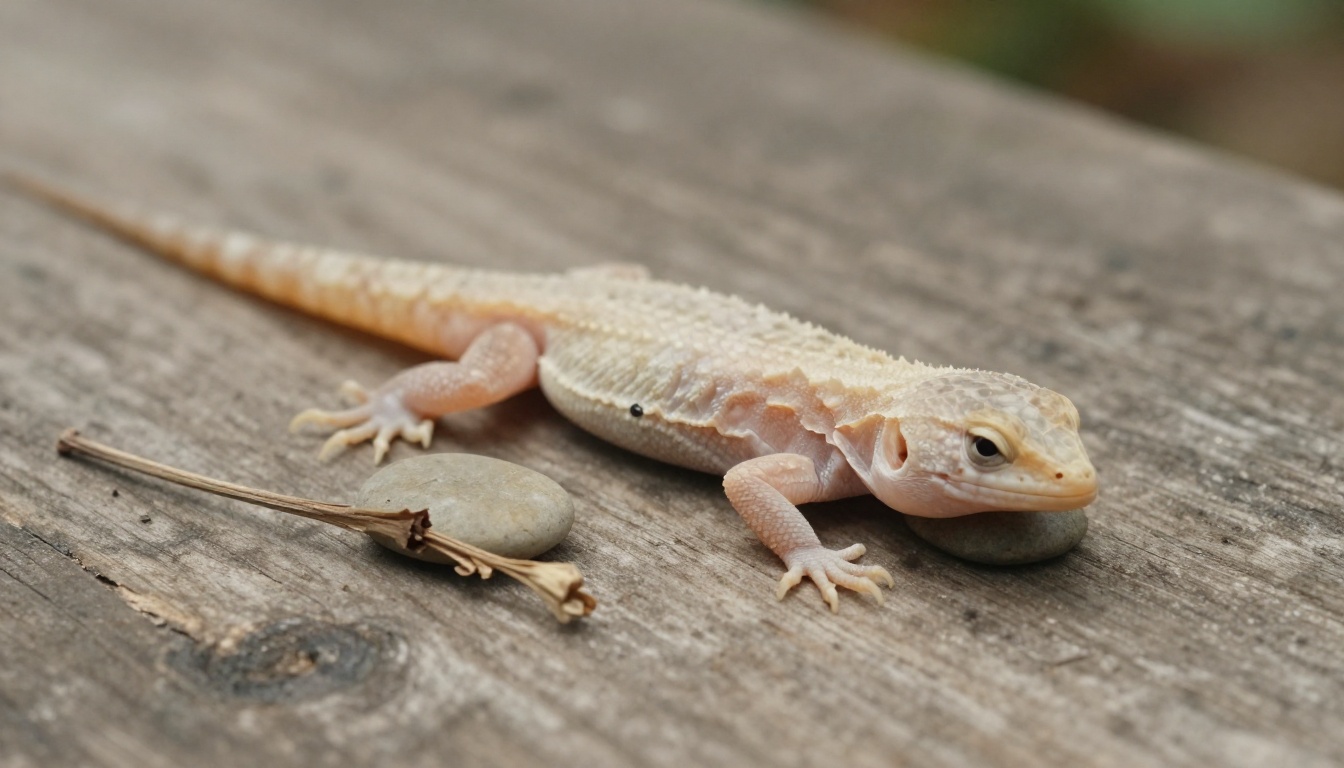
Scientists have produced the first gene-edited reptiles — anole lizards with albinism, created by disrupting the pigmentation gene TYR. The work opens new possibilities for reptile developmental biology.
A small green lizard, pale where it should be pigmented, has become an unlikely landmark in genetics research. Scientists at the University of Georgia produced the first gene-edited reptiles on record: brown anole lizards (Anolis sagrei) with albinism, according to a study reported by Phys.org.
The team used CRISPR-Cas9 to disrupt TYR, the gene responsible for tyrosinase — an enzyme essential to melanin production, the study found. Without functional tyrosinase, the lizards developed with no pigmentation: white skin, pink eyes, the visible markers of albinism at the cellular level.
The technique required a specific delivery method. Researchers injected the CRISPR components directly into unfertilised eggs still inside the female, Phys.org reported. Reptile eggs begin developing a shell almost immediately after fertilisation, which had made gene editing in this group of animals technically difficult for years.
Why anole lizards
The brown anole is already a widely used model organism in biology. It regenerates its tail, adapts its pigmentation across environments, and shares enough genomic architecture with other reptiles — including crocodilians and, distantly, birds — to make findings transferable, according to the researchers.
The choice of a pigmentation gene was deliberate. Albinism produces a clear, observable phenotype: researchers can see immediately whether the edit worked, without invasive testing. TYR served as proof-of-concept, the study noted, rather than the end goal.
The team reported that the albino lizards were viable and survived to adulthood, a result that confirms the technique can produce heritable edits across generations.
What this means for albinism research
For the albinism research community, the significance sits at the molecular level. The TYR gene is one of several genes whose mutations cause oculocutaneous albinism in humans. Having a living reptile model in which that gene has been precisely disabled gives researchers a new platform for studying how pigmentation pathways develop and vary across vertebrate species, according to Phys.org.
Previous gene-editing work in vertebrates concentrated heavily on fish, mice, and a handful of other mammals. Reptiles — roughly 10,000 species — had remained outside that toolkit until now, the report noted.
The researchers described the work as a platform, not a single experiment. Future edits could target genes involved in limb development, sensory biology, or regeneration, they said.
One lizard, colourless against a laboratory background, marks the edge of what was previously possible.
Keywords
Core topics and entities mentioned in this summary.